Problem
Hard-to-reach verification and finance
Response
OCIS helps projects prepare for formal verification and climate/nature finance in accessible, staged steps.
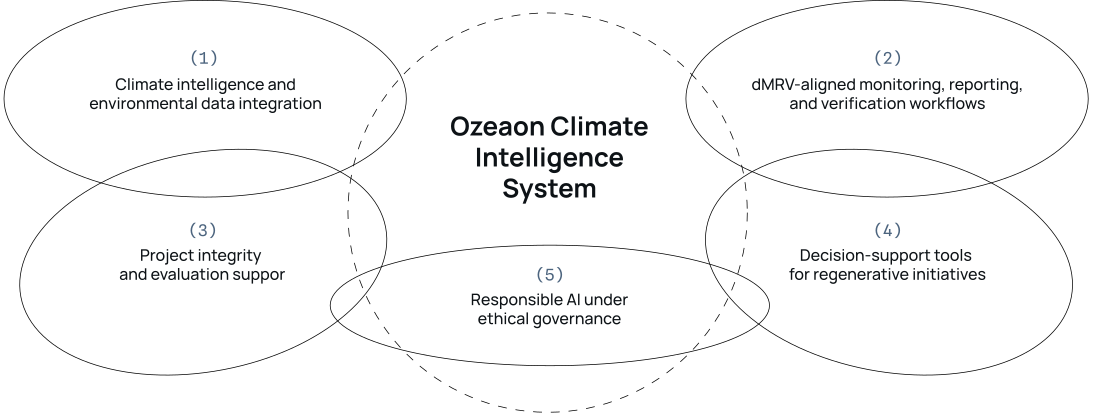
OCIS is Ozeaon's adjacent platform for climate intelligence, project integrity, dMRV-aligned workflows, evidence-based reporting, and decision support for regenerative initiatives.
While the core Ozeaon Platform connects knowledge, participation, projects, open calls, organisations, and funding pathways, OCIS is an AI powered application layer built to add the deeper intelligence, verification-support, and market-enablement layer.
OCIS is currently in active development — an AI-powered application layer being built to extend the Ozeaon Platform with climate intelligence, verification support, and market-enablement for regenerative projects.
OCIS is a separate but connected intelligence and integrity platform within the broader Ozeaon ecosystem. It is designed to support regenerative projects with structured evidence, project integrity assessment, climate intelligence, dMRV-aligned workflows, reporting readiness, and future verification-support pathways.
Many regenerative projects struggle not because they lack value, but because they lack the evidence infrastructure needed to communicate value credibly.
Smaller projects are often excluded from carbon, biodiversity, and broader environmental markets because verification can be too costly, fragmented, technical, or complex. Funders, institutions, and market participants need stronger evidence, transparency, comparability, and accountability.
OCIS is designed to help close this gap.
By supporting standardised assessment, project integrity signals, dMRV-aligned workflows, and evidence-based reporting, OCIS can help regenerative projects become easier to evaluate, support, finance, and scale.
OCIS helps projects prepare for formal verification and climate/nature finance in accessible, staged steps.
OCIS structures project claims, data, documents, methods, outputs, and outcomes.
Integrity signals and reporting readiness can help improve project evaluation.
dMRV-aligned workflows help projects document progress and avoid unsupported claims.
The core Ozeaon Platform is designed for accessible ecosystem participation: learning, publishing, project visibility, open calls, organisation profiles, partnerships, and future funding pathways.
OCIS is designed as a deeper technical AI enabled layer for project integrity, climate intelligence, evidence workflows, and verification-readiness.
Together, they allow Ozeaon to support both community-facing participation and higher-value trust infrastructure within one broader mission.
Ozeaon Platform
Public-facing ecosystem platform
OCIS
Adjacent climate intelligence and integrity platform
Ozeaon Platform
Educational Resources, Articles, Projects, Open Calls, Organisations, Innovation Network, Profiles, DAO activity, Payments and funding
OCIS
Project integrity, climate intelligence, dMRV-aligned workflows, evidence-based reporting, data integration, verification support, market readiness, decision support
Ozeaon Platform
Core platform development and launch preparation
OCIS
MVP design, development and launch preparation
Ozeaon Platform
Learners, researchers, educators, project builders, organisations, communities, funders, creators
OCIS
Project creators, institutions, funders, dMRV specialists, research partners, living labs, technical partners, verification collaborators
OCIS is designed around practical capabilities that help projects move from visibility toward evidence, integrity, and readiness.
Use earth observation, environmental data, climate context, location-specific indicators, and project-relevant insights to support better decisions.
Connect project information with relevant data sources such as field data, remote sensing, ecosystem indicators, monitoring records, reports, and partner datasets.
Assess whether a project has clear goals, evidence, governance, methodology alignment, community context, and implementation readiness.
Support digital monitoring, reporting, and verification processes through structured data, documentation, and reporting logic.
Create more comparable ways to evaluate project readiness, evidence quality, reporting completeness, and claim integrity.
Help project creators, funders, institutions, and governance participants interpret evidence responsibly.
Support clearer understanding of climate risks, ecological relevance, implementation barriers, and potential impact pathways.
Help eligible projects prepare for external verification, climate finance, nature finance, biodiversity markets, or institutional funding pathways.
dMRV means digital monitoring, reporting, and verification.
OCIS is planned to support these workflows by helping projects organise evidence, connect data, document activities, track progress, and prepare clearer reporting packages.
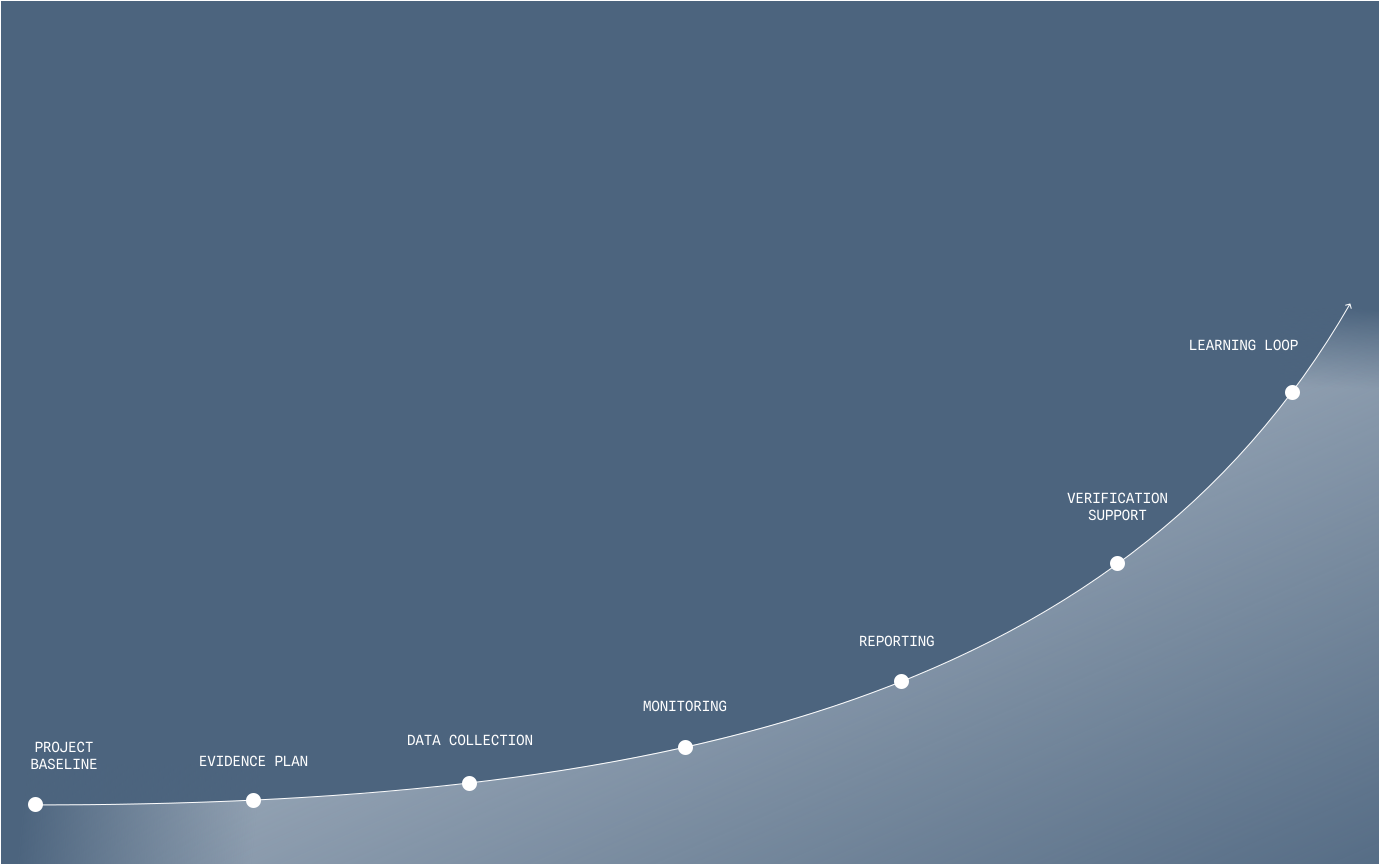
Baseline → Evidence Plan → Data Collection → Monitoring → Reporting → Verification Support → Learning Loop
dMRV means digital monitoring, reporting, and verification.
OCIS is planned to support these workflows by helping projects organise evidence, connect data, document activities, track progress, and prepare clearer reporting packages.
Define the project context, location, ecosystem type, goals, stakeholders, risks, and starting conditions.
Identify the evidence needed to support project claims, monitoring needs, and reporting requirements.
Gather project records, field observations, partner data, documents, images, sensor data, remote sensing outputs, or other relevant evidence.
Track activities, outputs, risks, progress, milestones, and environmental or social indicators over time.
Generate structured reports that explain activities, evidence, assumptions, results, and limitations clearly.
Prepare information for external review, institutional assessment, funder due diligence, or formal verification pathways where appropriate.
Use outcomes and feedback to improve project design, implementation, reporting, and future decision-making.
Regenerative projects need clear ways to show what they are doing, why it matters, how progress is measured, and what evidence supports their claims.
OCIS provides structured integrity and evidence tools that help projects organise their information and communicate credibility more clearly.
Basic project description, location, team, goals, ecosystem type, methodology, timeline, and stakeholders.
What the project claims it will achieve, what assumptions those claims depend on, and where uncertainty remains.
Documents, datasets, images, reports, field observations, maps, monitoring data, references, and partner inputs.
Structured indicators showing evidence completeness, reporting readiness, governance quality, data quality, and risk awareness.
Future workflows for expert review, community review, funder due diligence, technical assessment, or institutional validation.
Exportable or shareable packages for funders, partners, governance participants, programmes, and external verification pathways.
OCIS helps project creators understand environmental context and risk more clearly.
Data Areas
Maps, project boundaries, site characteristics, terrain, land or coastal context, jurisdictional overlays, and regional environmental indicators.
Satellite imagery, change detection, land and coastal analysis, vegetation and habitat patterns, surface conditions, and other advanced Earth Observation insights relevant to project monitoring and context assessment.
Climate exposure, hazard context, vulnerability, adaptation relevance, resilience considerations, and location-specific climate intelligence.
Species, habitat, ecosystem services, restoration context, ecological indicators, environmental sensitivity, and relevant conservation datasets.
Field observations, project updates, images, documents, activity logs, sensor data, partner records, and other project-linked monitoring inputs.
Relevant frameworks, methods, reporting standards, verification pathways, integrity criteria, and eligibility requirements.
Stakeholders, consent, local relevance, participation, benefit-sharing, and social safeguard considerations.
OCIS is designed to help credible regenerative projects move toward stronger support pathways.
The goal is not to make unsupported claims or bypass formal verification.
The goal is to help projects become more prepared, better documented, and easier for funders, institutions, and market participants to assess.
Support clearer evidence and reporting for climate-related funders, programmes, and financing pathways.
Help projects prepare better documentation for biodiversity, restoration, ecosystem services, and nature-positive value pathways.
Provide structured information that helps funders and institutions evaluate project quality and risk.
Support reporting packages for public, philanthropic, institutional, or mission-driven programmes.
Help eligible projects understand what may be required before formal certification, validation, or market participation.
Future premium services for institutions, networks, funders, and project portfolios requiring stronger assessment and reporting support.
OCIS uses AI where it is necessary, proportionate, sustainable, accountable, and mission-aligned.
AI should not be used as a general-purpose marketing feature or attention layer. Within OCIS, AI may support knowledge navigation, evidence organisation, risk interpretation, advanced data analysis, report preparation, environmental intelligence, and decision support — but only under clear review, human oversight, and ethical safeguards.
A core principle of OCIS is that AI use should remain visible, measurable, and accountable. Users should be able to understand when AI is being used, why it is being used, and what kind of resource impact that use may create. The application includes a feature for users to view their AI footprint from using OCIS features, including the estimated environmental cost associated with AI-supported analysis, reporting, or intelligence functions.
Responsible climate intelligence cannot ignore the material footprint of the tools it relies on. OCIS helps users understand how the negative impacts associated with their AI use relate to the positive outcomes of their work. For projects using dMRV-verified methodologies, this creates the possibility for users to see how verified ecological outcomes and project impacts may help balance, compensate for, or exceed the environmental cost associated with AI-supported OCIS use.
The AI Center of Excellence and Ozeaon Foundation guides responsible AI development so that any intelligence system feature remains accountable, transparent, environmentally aware, and aligned with regenerative outcomes.
Use AI only where simpler tools or human-led processes are insufficient.
Match model complexity and resource use to the value and risk of the use case.
Evaluate energy, infrastructure, hardware, lifecycle impacts, and operational footprint.
Ensure AI supports human judgement rather than replacing accountability.
Use relevant, permissioned, contextualised, and quality-controlled data.
Document assumptions, data sources, limitations, uncertainty, review decisions, and when AI has been used.
Give users a way to see the estimated AI-related footprint associated with their use of OCIS features.
For dMRV-verified projects, help users relate verified outcomes to the AI footprint of platform use — without implying a vague or automatic offset.
OCIS is being developed through collaboration, not isolation.
Because project integrity, dMRV, climate intelligence, and environmental data systems require scientific credibility and field validation, OCIS is intended to evolve through a consortium model involving research institutions, living laboratories, field sites, technical partners, dMRV specialists, restoration practitioners, ocean and biodiversity experts, and mission-aligned organisations.
Ozeaon is seeking collaborators who can help co-design, test, validate, and refine OCIS through real-world regenerative contexts.
Real-world sites where project integrity, monitoring, and reporting workflows can be tested.
Scientific partners supporting methodology, data quality, review, and credibility.
Specialists in monitoring, reporting, verification, standards, and market-readiness pathways.
Domain experts supporting ecological relevance and project-specific assessment logic.
Machine learning, software, geospatial, database, sensing, and climate data collaborators.
Organisations interested in supporting public-interest climate intelligence infrastructure.
A mangrove restoration project uses OCIS to organise evidence, monitoring records, and reporting for easier funder evaluation. A seaweed farming initiative similarly documents site conditions, methods, and risks, building evidence for blue economy finance pathways.
A foundation or institutional funder uses OCIS-generated reporting packages to compare project readiness, evidence quality, risk awareness, and implementation credibility across a portfolio of regenerative projects.
A restoration pilot uses OCIS to package biodiversity observations, ecological indicators, partner reports, and monitoring updates into a structured reporting workflow.
A university, field site, and technical partner collaborate with OCIS to test a dMRV-aligned workflow for regenerative coastal projects, refining methods through real-world validation.
You might also be interested in
Ozeaon is being developed with researchers, educators, innovators, organisations, communities, funders, and partners who believe knowledge should lead to action.
Join early access, explore partnership opportunities, or preview how the platform is being built.